The Thought Lab, AI Face, & What to See/Hear/Read
The clothing or the coifs could be from any era, but the physiques and faces beneath the maxi dresses and the makeup could only be from the 2020s. This is a deeper shift than just a hemline or a platform shoe versus a spike heel. And I think it heralds a deeper change in our culture, too.

Hi and Welcome! This is the very first issue of Palimpsest of Flesh. So if you are reading this, you can say you got in on the ground floor. I’m so grateful for your support. A bit of an intro for anyone who doesn't know me yet below (or skip to the Corpus if you already are familiar with me and my work).
Introduction
Hi, I’m Starre Julia Vartan, and I’m the author of The Stronger Sex: What Science Tells Us About the Power of the Female Body. This newsletter is launching at the same time as the research and writing process for my third book, Warriors, Weavers, and Wanderers: The Real Story of Our Female Ancestors (working title).
My writing and work experience has been wide at times, and deep in others which reflects my origins and strongest influences. I come from a peripatetic family (few people on either side have stayed put in one country—or even continent—for more than a generation (and most of for less time than that)).
I was born in Australia, the child of an Aussie mother and New Yorker father who met in Montreal, and grew up primarily in New York, raised by my grandmother. I now split my time between the Illawarra coast of Australia (south of Sydney) and Bainbridge Island, Washington. The two sides of my family include medical professionals and artists both formal and informal (painters, photographers, poets, designers, lots of dancers, and one opera singer; I create ceramic sculptures). Everyone I'm related to swims, almost everyone dances, and there are a few very sporty folk—I'd include myself in that category but it’s notably quite an active family overall! And opinions, there are aplenty. We talk even more than we move, as all of us are highly, highly verbal people.
There have been a lot of marriages, and as many divorces (I can’t think of anyone on either side who remained married for longer than a couple decades) and as suits a traveling family, my own ancestry is rooted in Lebanon, Greece, Armenia (check my last name), Germany, England, Scotland, and Wales.
Briefly, I will note that I’ve always been interested in science, human and animal bodies of all kinds, and was pre-med in college, eventually switching my major at the last possible moment to geology, which I have Bachelor of Science in. I worked briefly as a geologist (hydrology specifically), then began my writing career in Manhattan and Connecticut. I was a successful and well-known blogger from 2005-2020 for my own site, and many other publications where I wrote both articles and columns for publications like Martha Stewart’s Whole Living, Plenty magazine, Audubon magazine, Heart magazine’s The Daily Green, Huffington Post, and E/The Environmental Magazine. I covered women’s health, environmental issues, sustainable design, and art. I was one of the early online voices in the ethical fashion and materials world and won awards and threw some seriously fabulous parties for my site, Eco-Chick.com.
I’ve been watching and thinking about what women have been told about their bodies, faces, and more intimate parts for decades now. I’ve also been reporting on the science and health of female bodies for as long, with an almost total focus on it for the past 5 years as I researched and wrote The Stronger Sex.
But I also have a passionate interest in how art, design, fashion and beauty influence our ideas of ourselves as women. I'm a ceramic artist and ecstatic dancer, as well as a writer who has attended a dozen NY and London Fashion Weeks, former beauty columnist, an experienced investigative journalist, and trained scientist. I see how all these worlds interact and overlap each other in a way that not so many other writers and thinkers do.
This newsletter is a way for me to interrogate those worlds, to challenge some of my own ideas, and share new research alongside new art (and the very oldest art), as well explore how environmental change affects women's lives, how beauty standards are twisting and evolving, and what health really means.
I think these things are all very connected!
Welcome to my thought-lab and thanks for being here.
Corpus: The living body of this issue
(a thought lab for my writing; aka the essay)
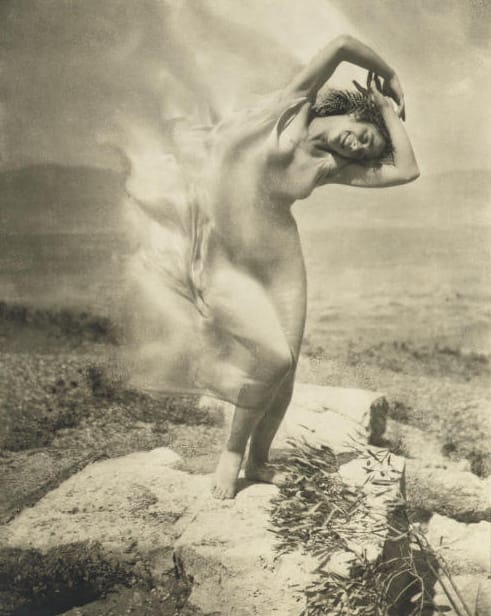
"Thérèse Duncan on the Acropolis, 1921" Edward Steichen, Public domain, via Wikimedia Commons
I guess I got what I asked for. And it's terrible.
A few years ago, I remember lamenting how styles hadn't changed much since the late 90s. I was nostalgic for the radical fashion shifts from the early 80s to the late 80s to the early 90s. When I was growing up I could just look at people's hair (sprayed to the skies or hanging in a lank, slackerly fashion?), shoes (scrunched socks with Reeboks or tights and Doc Martens boots?), and makeup (garish or ghoulish?) and know exactly what year it was. (And we all know how different style was in the 50s, the 60s, and the 70s, each decade with plenty of visual identifiers!)
But then that style evolution kinda stopped. Starting sometime in the late 1990s, hairdos, shoes and denim just kept staying the same. Skinny jeans were the norm for almost 20 years. You could have gotten a haircut in 1998 and it wouldn't have been seen as old-fashioned in 2012. As Kurt Anderson wrote in Vanity Fair in 2011:
In our Been There Done That Mashup Age, nothing is obsolete, and nothing is really new; it’s all good. I feel as if the whole culture is stoned, listening to an LP that’s been skipping for decades, playing the same groove over and over. Nobody has the wit or gumption to stand up and lift the stylus.
Anderson theorizes its because technology changed (and rapidly), geopolitics shifted and there was a big recession, so people didn't have the stomach for more topical changes to our shared visual landscape.
Whatever it was, check out the video below from 2018 for the 20th Anniversary of Sex and The City; there's almost nothing, style-wise, from the late 90s that wouldn't have been normal to see 20 years later on young women.
But in the last 5 years, there has finally been a change. There's a new style, and it's nothing like the old style. But it's less about clothing extremes or haircuts. It's the faces themselves that now look "old-fashioned."
Can you imagine a show today from a major network featuring four young working women with un-altered faces and relatively natural teeth? Compare the Sex and the City cohort with the Selling Sunset ladies, below.

We're in the age of AI face. I've watched dozens of YouTubes dissecting What Is Happening To Celebrity Faces, and way too many Tiktoks wherein one plastic surgeon or another pontificates on what procedures have or haven't been done to famous face or physique. We are all examining and obsessing over this subject. (My fave breakdown so far is from Janae Daniyel and it's entitled: "Nobody Looks Human Anymore… And It’s Getting Scary" (below).)
Faces are altered, in some cases, beyond recognition. Bodies change seemingly overnight. The clothing or the coifs could be from any era, but the physiques and faces beneath the maxi dresses and the makeup could only be from the 2020s. This is a deeper shift than just a hemline or a platform shoe versus a spike heel. And I think it heralds a deeper change in our culture, too.
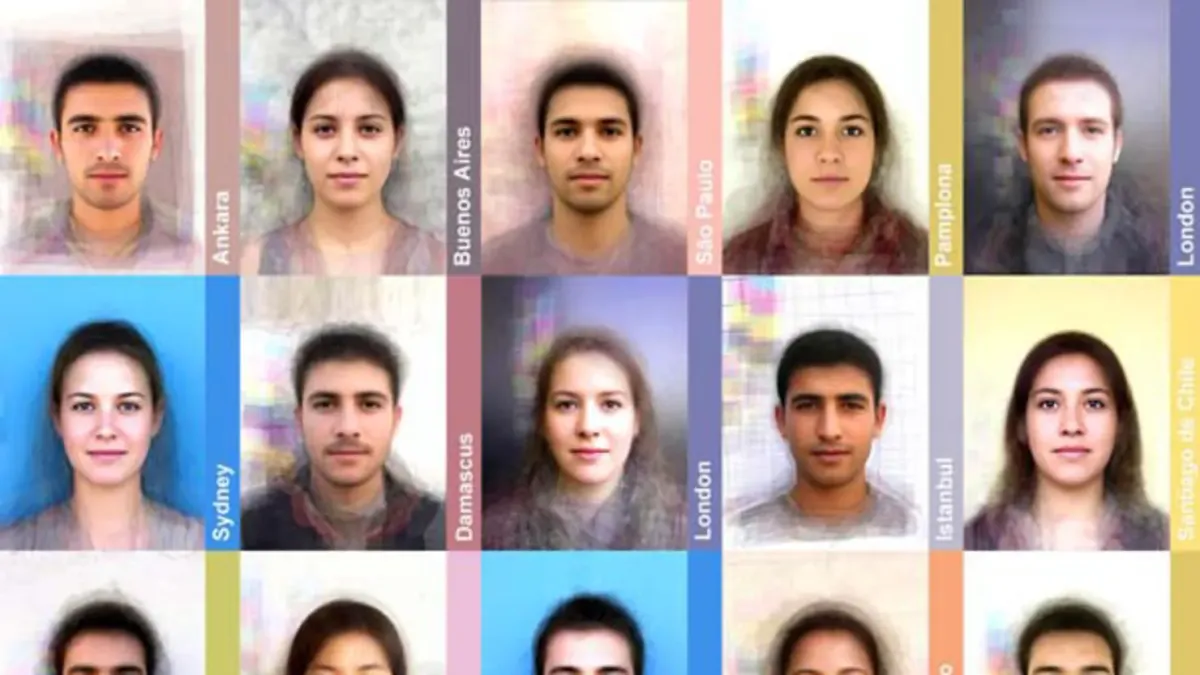
This wax-face, or AI face, looks filtered by an app, optimized for a screen—but it's IRL. It's a computer's understanding of a human face, with all the character and quirk removed. If you watch these altered faces over time, as the surgeries layer on top of each other, the visages become more and more similar. Like all these different faces are merging into one.
As Janae says in the video above, the plastic surgeries are giving strong "uncanny valley." And this look is trickling down to all of us—even if you can't afford an upper bleph or lip injections, the market for cosmetics that produce "glass skin" is huge and skincare is now serious business for people in their early 20s (which I can personally attest to it not being 20 years ago).
AI face isn't only affecting celebrities, since "We're all in the same online spaces now," Emily Kirkpatrick said on the July Mess World podcast. "Celebrity isn't quite as rigorously defined as it once was. You can be a niche influencer or celebrity in your own right, so when you're talking about, 'oh These are just beauty standards for celebrities,' we've long since conflated who is a celeb and who is a regular person—and who we have to be to be consumed online," said Emily.
So now the facial "imperfections" that used to be the concern of the very wealthy and bored, or people who made a living with their faces and bodies are being eradicated by the rest of us too.
Crucially, this new aesthetic isn't just about looking younger, because many of the women getting these alterations are already young. It's about looking like a blank, generic version of the beauty standard as possible.
But wait: Isn't looking unique and individual—and being recognizable—an important part of being a celebrity? A person?
Not anymore.
Thinking abt the succession from nullifying Roe > rise of trad wives > freakouts about birth rates > wax-face plastic surgery > pro-ana content >the normalization of pedophilia by political leaders (incl women). It's all hopefully the extinction burst of the patriarchy. (Am I missing anything?)
— Starre Vartan (@starrevartan.bsky.social) 2025-11-21T07:26:33.024Z
AI Face and the sameness it demands is just one facet of a larger push to disappear difference.
Look at the trad wife trend—it's about one thing above all: Conformity. So is removing women's right to autonomy over their bodies—there is no equal right to abortion in the United States anymore. And there's been a slow-rolling general panic about "not enough babies"—with one party insisting that all (white) women should be having more children or civilization will fall (the rhetoric is that overheated). That's another kind of conformity: All women should be mothers.
Then there's the incredibly hateful attacks on trans people, who are challenging, among many ideas, the narrow concept that we should all fit into one of two gender categories. Conformity dictates that we should all stay in the lane we have been assigned a birth.
Pro-ana content is popular again, at the same time as Ozempic and other GLP-1s are being used way outside of health care needs, and mostly among women. How many ads have you seen for telemedicine providers that suggest GLP-1s to "get rid of that extra 10 pounds" and showing an already-slim woman?
All of us being the same body size and shape is also about conformity, a real "eff you" to the idea of Body Positivity, or Embracing All Sizes that was so popular just 6-7 years ago. Because being happy with, or even just neutral about one's body means it's not conforming to an outside standard.
Not to mention that this trend also erases cultural, racial, and ethnic differences—just like DEI has been erased from so much of our political and governmental worlds.
So we finally have a highly visible, 2020s-coded style, but it's not the creative and unique new vibe I was hoping for when I wished styles would change.
This one is all about erasing our individuality, promoting the idea that we are all interchangeable, and importantly, that we should feel really good about losing ourselves to the group. That we should conform to what Janae calls the "manmade" look—literally. Because all these trends result in a look that is the apotheosis of a patriarchal idea of what women and girls "should be."
And the more we look at these "area 50 faces," these Frankenstein's monsters, these shells, the more more normal they become.
Not just because it's boring and creepy, but also because it's inhumane. Even the beginnings of the research for my next book have shown me that from the earliest days of being human, we celebrated the uniqueness of ourselves and our communities.
The manmade, computer-generated face and body is the new style. It's the Era of Conformity, and I hate it.
Anconeus* Archive
Small but mighty notes — contractions of thought, brief flashes of muscle memory.
*The Anconeus Muscle is a tiny connector between the arm’s upper humerus and lower ulna which allows elbow extension.
HEAR IT
Women's Running Stories pod
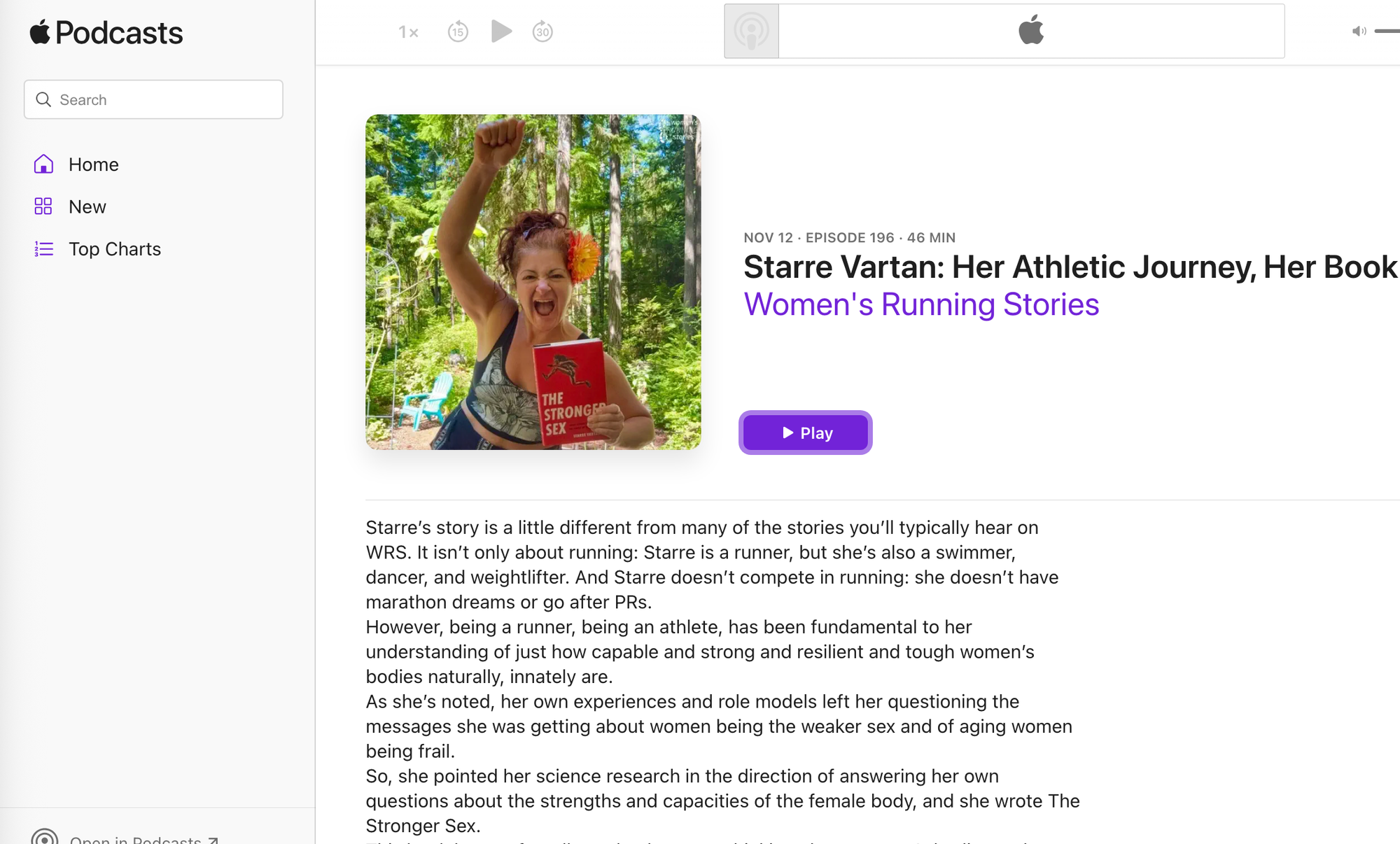
I had a great time talking about my running journey with Cherie on the Women's Running Stories podcast. Cherie wrote:
This book has profoundly evolved my own thinking about women’s bodies and our abilities, and it shines an even brighter light on how underestimated, disrespected, and held back we have been in modern times. Much more so than I’d ever fully appreciated.
Starre’s book has also left me feeling even more confident and thankful in the body I have, and also even more optimistic about its abilities as I age.
Musicians Speaking Across Time to Each Other and to Us
Everybody Supports Women by Sofia Isella is a banger of a song, and the lyrics:
Everybody supports women until a woman's doing better than you
Everybody wants you to love yourself until you actually do
It was something about her hair, so perfectly fallen
She was nice, and smart, and funny, and got everything she wanted
And she does charity, isn't that the most obnoxious thing you've heard?
Her popularity, she's too pretty for her own good
She's probably self-centered, we hate her and she's nothing
If everybody leaves her, then she had it coming
reminds me SO much of one of my fave Ani DiFranco songs from the 90s, 32 Flavors:
God help you if you are an ugly girl 'Course too pretty is also your doom
'Cause everyone harbors a secret hatred For the prettiest girl in the room
And god help you if you are a phoenix, And you dare to rise up from the ash
A thousand eyes will smolder with jealousy, While you are just flying past
SEE IT
Emory University Health Storytelling
I spoke with Maryn McKenna about my book for Emory University's Health Storytelling Series; it was a wide-ranging conversation and a wonderful one to have with such an experienced fellow journalist.
Marcella!
Not a new show, but new to me! If you like dark British crime thrillers, Marcella is a great one with a wonderfully twisted main character and the usual high level of production, writing, and acting that comes out of the UK. Bonus: Florence Pugh plays a second wonderfully twisted female character in Season 1, which I'm fully binging every night this week (and next week, because there are a few more seasons).
READ IT
 Aparna (Amy) Divaraniya, PhD
Click through to read this fantastic summation of what it means for women's health that the black-box warning has been removed from HRT supplements, and what's next. From Amy Divaraniya, a women's health expert and one of the experts I interviewed in The Stronger Sex.
Hot Off The Presses
Here's what I've published most recently:
Not Every Women’s Midlife Health Issue is Perimenopause for New Scientist

The first of a couple of feature stories based on my book for New Scientist, this one analyzes how both doctors and patients can make assumptions about healthcare for women in midlife.
While it’s wonderful that perimenopause and menopause are receiving some (VERY!) long overdue attention, there’s also some pretty serious bandwagoning going on, with every health complaint, mental or physical, assigned to the perimenopause category. This can mean overlooking other serious health issues that can mimic the symptoms of perimenopause. And with women self-diagnosing and then going through telehealth providers for HRT, this can get dangerous, fast.

I interviewed Stephanie for the piece, who told me about how what she thought were perimenopause symptoms were actually a life-threatening fibroid which she finally got removed before it caused any more problems.
From the article: “Classic hallmarks [of perimenopause]– hot flushes, night sweats, vaginal dryness and midlife changes in menstrual bleeding patterns – are highly likely to be hormonally driven. But most other symptoms commonly cited online, from sleep problems and joint pain to mood changes, may have multiple contributing factors.
That’s the challenge: fatigue might be due to fluctuating oestrogen levels, but it could just as easily be caused by an underactive thyroid, iron-deficiency anaemia, depression or autoimmune conditions like lupus. Brain fog might signal perimenopause, but could be the result of a vitamin B12 deficiency or sleep apnoea, or be an early sign of neurological issues. “Pain with intercourse can be due to perimenopause, but it also can be other conditions like sexually transmitted infections or some specific skin conditions like sclerosis,” says Mary Parman, who has practised obstetrics and gynaecology for 20 years in Silicon Valley, California.”
Breastfeeding and Breast Cancer in Nature

In my first piece for Nature, I was assigned an embargoed study (it hadn’t published yet) and had to put this story together over a weekend. I was able to speak with a principal researcher, Sherene Loi as she was on her way to Berlin for the prestigious ESMO conference, where she was presenting her important findings that breast cancer risk can be reduced by the immune mechanisms that occur in the breast during pregnancy and breastfeeding, especially. Fascinating new research that can benefit all people as we search for a breast-cancer vaccine for those immunity affected cancers.
That's all for my first newsletter! DONE.